
Cathedrals of Pizza
Everyone has a first memory of pizza. Mine, however, is not like yours. It’s of a paper-thin slice of New Haven apizza served up at a birthday party when I was four. A disk with blackened edges and a blood red center. My first pizza memory does not have cheese.
New Haven-style pizza, or apizza, has ascended in the world. The charred crust served at Frank Pepe Pizza Napoletana, Sally’s Apizza, and Modern Apizza (famous in that order) has gone national. Between Sally’s and Pepe’s the next few years should see 1,000 locations opened nationwide. Food writers have celebrated these new restaurants for what they always have—serving pizzas that rank among the best in the world.
However, Connecticut locals have demurred. There’s something odd, we say, about stopping into a slick mall restaurant and pairing one of these pies with a Negroni and a large screen TV. Sally’s ambition is to be the “Chipotle” of pizza strikes a particularly uncomfortable note. We feel apizza should only be made by a guy in a white T-shirt and handed over in a box by someone chewing gum. Pizza is big business in New Haven, but it’s done with faded signs, vinyl banquettes, and unmanufactured grit.
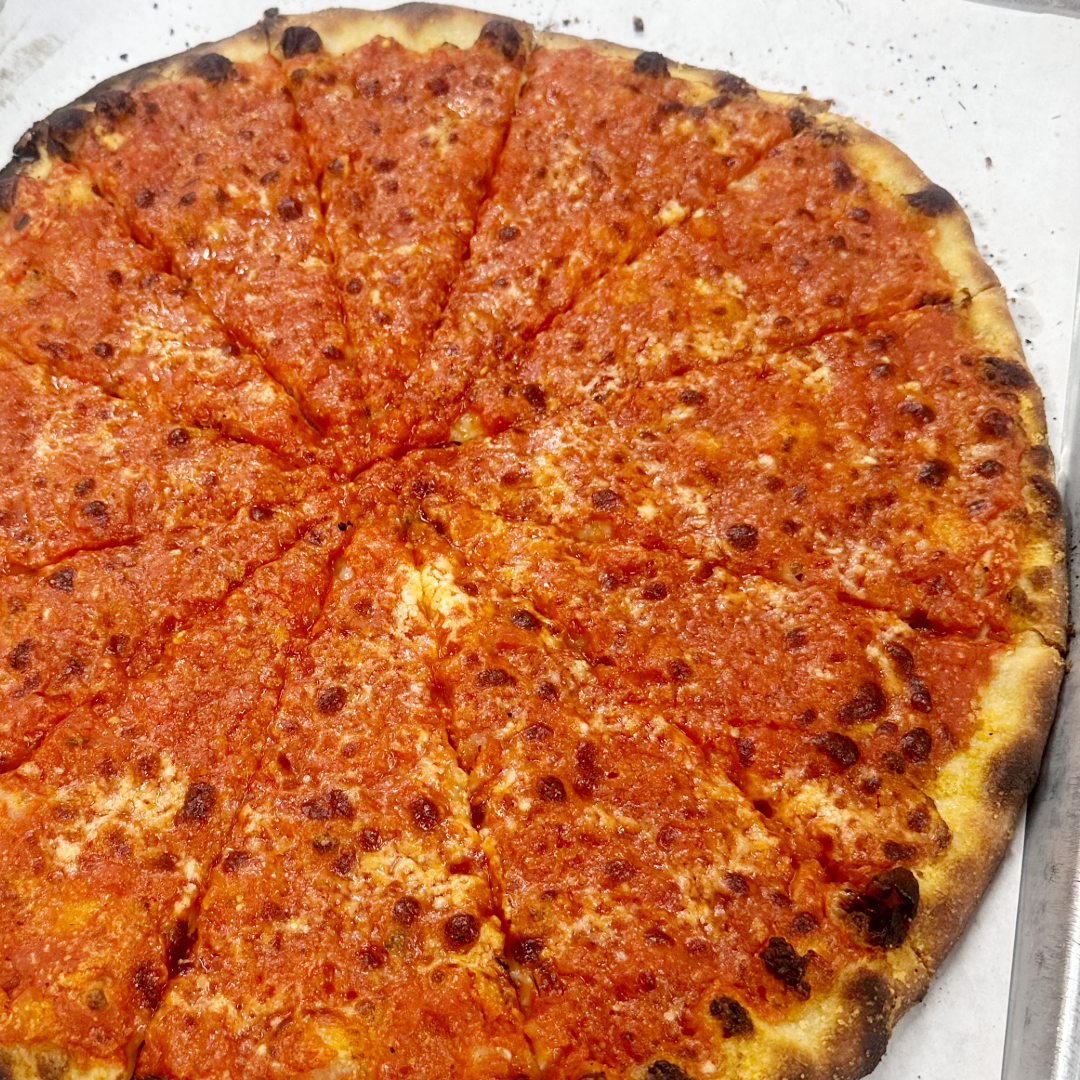
Original Tomato Pie, Frank Pepe Pizzeria.
We even bristle at the word “apizza.” To a local, it refers to the category, not the product. We never order “an apizza” or use it in its plural (it’s a single noun). Rather, the word divides the world into two kinds of pizza, one of which we infinitely prefer.
That’s because New Haven pizza isn’t like so much high-end food today: driven by craft, ingredients, and the singular genius of a chef. It’s a system rather than a recipe. A set of practices, not a product of personal expression.
To be sure, there is art. The recipes are secret, and today the pizzerias boast they use only the “freshest seasonal” ingredients. But in New Haven, we’ve watched innumerable food trends wash over our pizzas—with the only discernable difference found in the descriptions on the menus.
The contours of the system are well known and hardly exotic. The flour is ordinary bread flour. The sauce, when present, is ground tomatoes, straight out of a #10 can. They don’t have to be Italy’s famed San Marzano tomatoes, but often come from Stanislaus, a well regarded restaurant brand from Modesto. The cheese is thin-sliced, whole milk mozzarella (probably made by another top brand, Grande). The dough is similar to what you find at many pizzerias, though it tends to be wetter and left to ferment longer.
The difference comes down to history and execution.
New Haven was once a coal port. Its large natural harbor can accommodate huge ships, but it needed railroads to make it thrive. And for that, you need coal. And it’s a strange quirk of geography that the coal in this region most often is anthracite, the purest, cleanest burning version. Unlike most coal, you can use it in an oven.
In the early part of the last century, Frank Pepe, a local restauranteur, commissioned ovens that would use coal to make pizzas (likely because it was cheap). And after a little tinkering, it became clear that this was something special. Apizza is not just about temperature. You can now get a home pizza oven that reaches 1,000 degrees. But it won’t be as fierce or as even, and won’t throw radiant heat, the infrared light from a coal fire that quickly chars the exterior of the pizza before the inside fully cooks. This is the magic, the peppery burn that leaves the rest of the flavor intact.
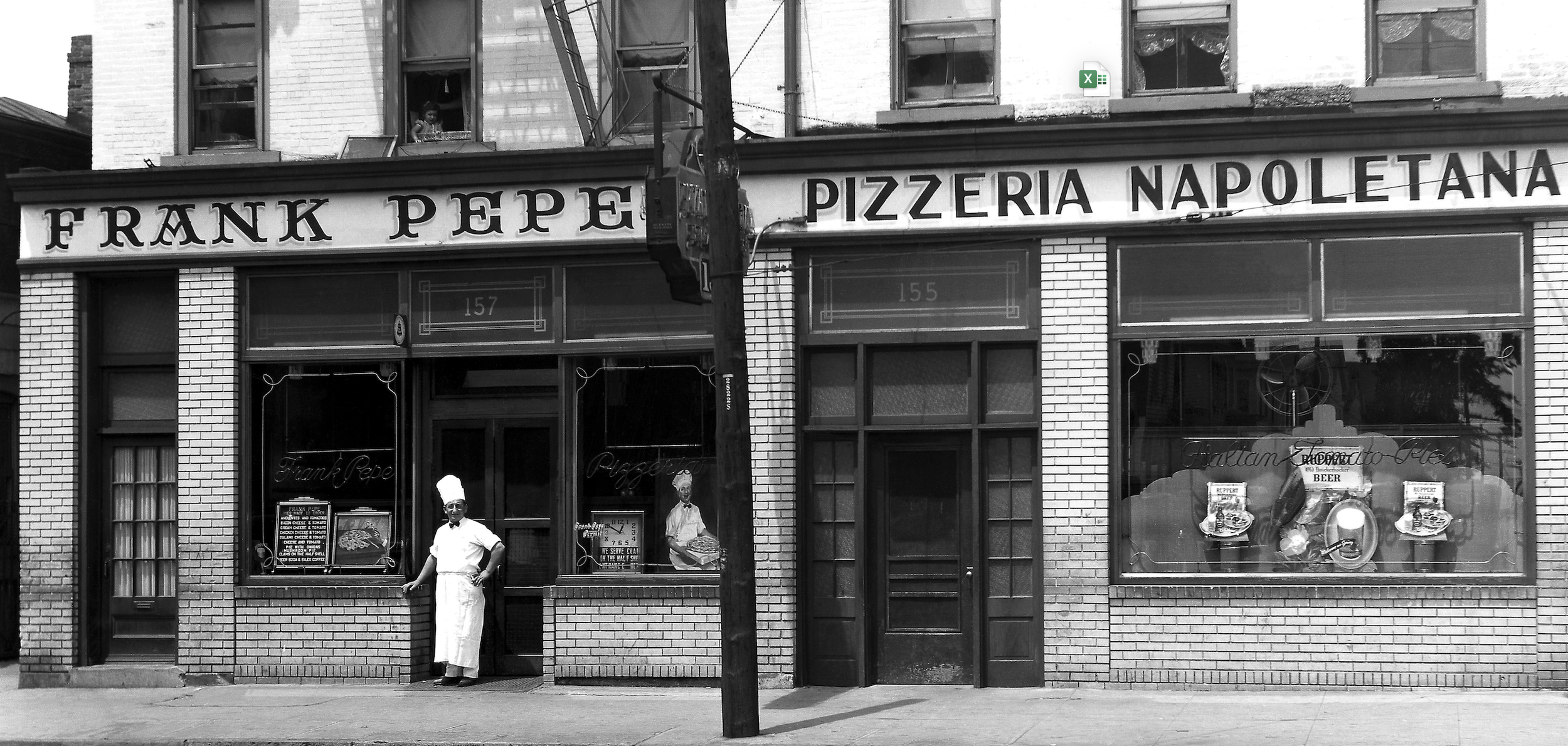
Frank Pepe at 157 Wooster Street, New Haven.
This unusual cooking method drives not merely the flavor profile of the pies, but the kinds of pizza that work well, and even how you order them. In New Haven, you have to ask for everything on the pizza, including the sauce and cheese. While no pizza comes without one or the other, not all have both. And if you call up a pizzeria and don’t say something like, “I’d like a meatball pizza with red sauce and mootz,” you will get asked if you want the last two of these.
You can find traditional toppings on apizza, like pepperoni, but if that’s what you want, you may be in the wrong place. The iconic pizza from New Haven is a Frank Pepe invention: white clam pie, a sauce-less concoction with clams, fresh garlic, and a small amount of cheese.
The secret to making this pizza work is the clams. During Frank’s time, Long Island Sound was a huge source of these mollusks, which were processed in factories nearby. The trick with clams is that they can’t cook for any length of time without turning into pencil erasers. Enter the coal oven.
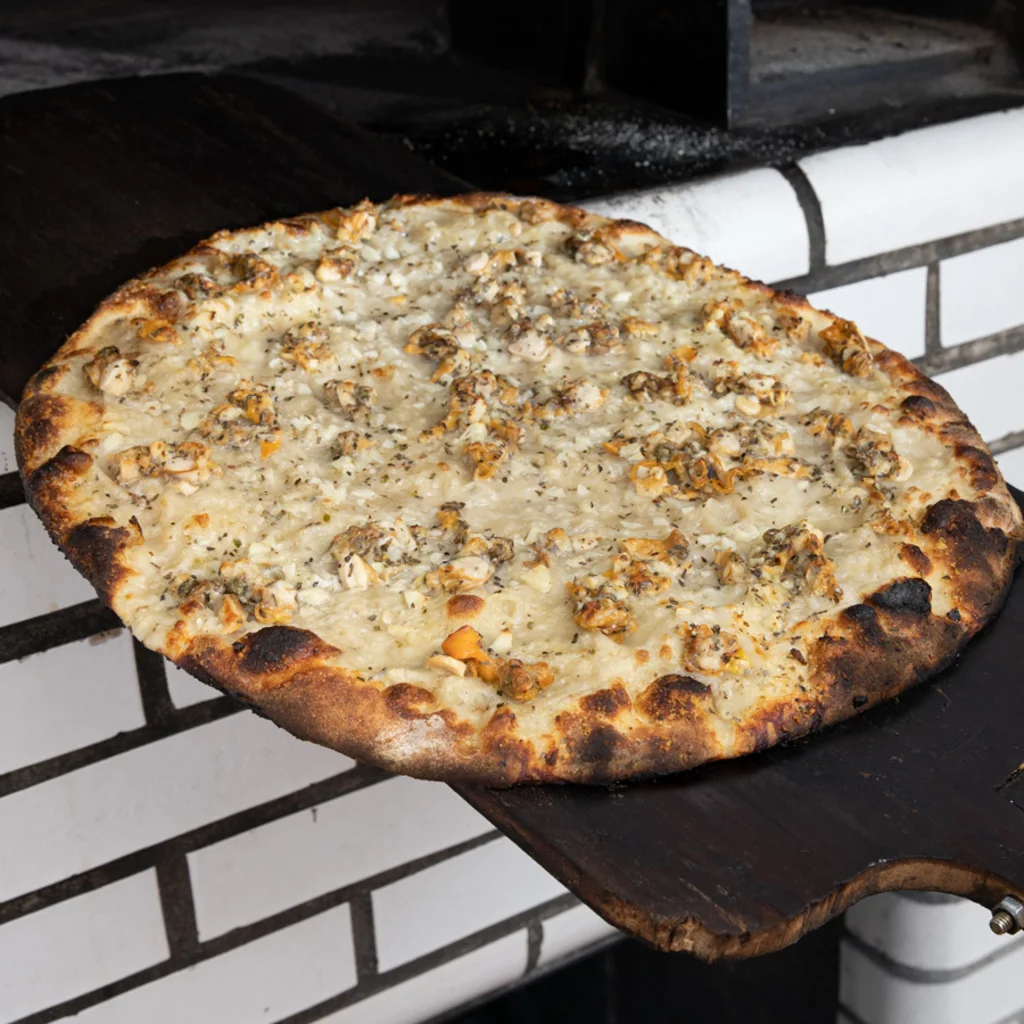
White clam pie.
Coal makes New Haven pizza a gamble. That’s because making it requires more than skill; you need rhythm. The pies must get launched into the oven, baked for a minute, and quickly rotated 180 degrees for another, and then pulled. While the heat of the oven is steady, it’s ferocious, much more so than that of a wood-fired oven. Done correctly, your clam pie crisps the outside crust, while the intense heat liquifies the cheese, garlic, and clam juice into a luscious sauce—without overcooking the clams. Five seconds off, and it’s good, but not sublime.
Similar is the “tomato pie,” which is my first pizza memory. It consists of nothing but dough and a thick layer of ground tomatoes with a kiss of romano (often locally called “grated cheese”). Done right, it emerges with half the tomatoes fire-roasted, and half still liquid, a combination some find strange, others amazing.
Doing this consistently without the right team and tools is impossible, which is why true New Haven pizza has historically been so difficult to replicate. Wood-fired pizza has rabid fans, but it is a different beast altogether. Wood burns differently, less intense and fickler, which is probably why Naples has celebrated pizza artisans, known by name. New Haven has iconic pizza cathedrals, held together by tradition.
Will such a tradition travel? The simple answer is “probably yes,” but not unchanged. Luckily, New Haven pizza is not monolithic: you can find plenty of stylistic adaption in New Haven itself. Even among the big three, Modern is heretical in its use of an oil-fired rather than coal oven. Throughout the metro area, dozens of excellent pizzerias, many in business for over 50 years, have adapted the basic idea to their own circumstances. They always adhere to the formula of minimalist sauce, scant cheese, and maximum power. They may not have a clam pie on the menu and might even put mozzarella on your pizza whether you ask for it or not. But they all deliver some version of the thin, charred crust that makes the style.
Sally’s and Pepe’s—which are actually kindred businesses founded by members of the same family—are taking different routes to expansion. Pepe’s is trying to go for close-as-possible replication, using carbon copies of its famous ovens, while Sally’s is being more ambitious and less traditional.
Still, for those who were raised on the real thing, only a few pizzerias get the style perfectly right. That’s because apizza is more than the sum of its parts, and one of those parts has to be a seasoned crew, steeped in decades of tradition, that bangs these things out at a breakneck pace every Friday.
So, if you ever find yourself in New Haven, make your way to one of the originals. It’s worth catching apizza in its high mass form. At the same time, New Haven pizza has always been more of an idea than an ideal, a system not a product. You may not replicate the feel, but if you come close enough to the taste, it’s still worth it.
